
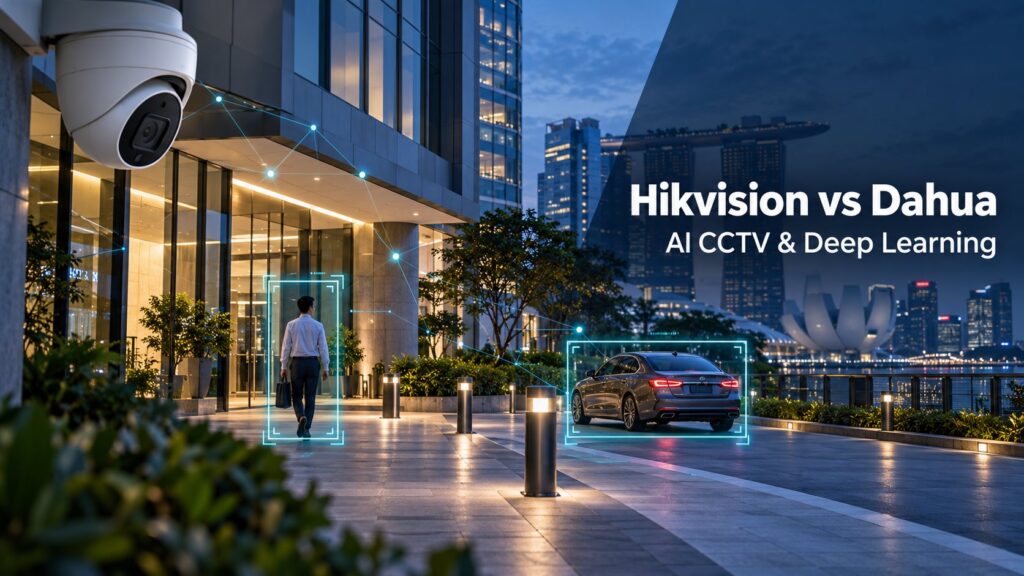
Hikvision vs Dahua is a useful comparison when choosing AI CCTV for a home, shop, office or warehouse in Singapore. Both brands offer deep learning features, but the real question is practical: which camera and recorder combination will give you useful alerts and help you find an incident quickly?
The ultimate benefit of Hikvision deep learning is turning recorded video into information you can act on. AcuSense helps distinguish people and vehicles from other movement, while compatible higher-tier systems add more advanced analytics and search. Dahua offers competing capabilities through WizSense, AcuPick and newer WizSeek systems. Neither brand is automatically the winner across every model or installation.
This guide compares their published capabilities and explains what to test before buying. It is a technology and buying guide, rather than an independent laboratory benchmark.
What does a Hikvision deep learning algorithm do?
Traditional motion detection looks for changes in the image. Moving foliage or changing light can therefore trigger an event even when nobody enters the area. Deep learning adds object classification: a trained model evaluates visual patterns to estimate what is moving.
According to Hikvision’s AcuSense documentation, supported cameras and recorders classify humans, vehicles and other objects. This allows users to filter alerts around the target types they care about. Supported perimeter rules can then connect that classification to a defined area or boundary.
For example, the useful event at a loading bay might be a person entering after closing time. The objective is to draw attention to that event while reducing interruptions from unrelated movement. Classification does not establish a person’s identity or prove that they intend to commit a crime.
Hikvision vs Dahua: AI CCTV comparison at a glance
| Requirement | Hikvision | Dahua | What to verify |
|---|---|---|---|
| Human and vehicle alerts | AcuSense on supported devices | WizSense with supported SMD features | Target filters, event rules and results at your site |
| Boundary monitoring | Supported line-crossing and intrusion analytics | Supported tripwire and intrusion analytics | Detection distance, direction settings and simultaneous AI channels |
| Search for a selected target | AcuSearch on compatible systems | AcuPick on compatible systems | Camera/recorder pairing and the footage that can be searched |
| Search using descriptions | AcuSeek, powered by Guanlan models | WizSeek, powered by Xinghan multimodal technology | Supported hardware, firmware, languages and search interfaces |
| Overall value | Depends on the specified system | Depends on the specified system | Installation, storage, software, maintenance and support costs |
These are functional comparisons, not claims that the technologies use identical algorithms or deliver identical performance. Confirm the regional datasheets and firmware requirements for the quoted products.
AcuSense vs WizSense: which gives better everyday alerts?
AcuSense vs WizSense is the most relevant starting point if your priority is receiving fewer irrelevant motion notifications. Hikvision’s AcuSense and Dahua’s WizSense both provide human and vehicle classification on supported products.
Dahua describes WizSense as an AI product family using deep learning. Its supported Smart Motion Detection (SMD) functions filter events by target type, while perimeter protection applies rules such as tripwire or area intrusion. Dahua also describes animal filtering improvements in SMD 4.0.
There is no defensible brand-wide accuracy winner from those descriptions alone. A well-positioned camera looking across a clear entrance may perform differently from one viewing a distant gate through rain, reflections and partial obstructions.
When evaluating Hikvision vs Dahua, ask for a demonstration using the same scene and comparable settings. Count both nuisance alerts and missed events. A system that stays quiet because its sensitivity is too low is not necessarily the better system.
Beyond basic detection: AcuSearch, AcuSeek and WizSeek
Target search helps narrow an investigation
AcuSearch and AcuPick address a different problem from alert filtering: finding relevant appearances of a selected person or vehicle in recorded footage. Hikvision lists AcuSearch alongside AcuSeek in its network recorder overview. Dahua’s AcuPick explanation describes comparing visual characteristics to retrieve potentially relevant clips.
Ask the installer to demonstrate the complete process: select a target, search the required cameras and time range, review the matches, and export a usable clip. Similar-looking clothing or vehicles can produce ambiguous results, so an operator still needs to verify the footage.
AcuSeek vs WizSeek: searching with words
Hikvision’s newer Guanlan-powered AcuSeek uses multimodal AI to connect written descriptions with video content. This can make investigation more convenient when you know an object’s appearance but do not know exactly when it appeared.
Dahua’s WizSeek offers description-based video retrieval using Xinghan multimodal technology. Therefore, natural-language search is not exclusive to Hikvision. The useful comparison is whether the specific system can find the objects and situations relevant to your premises.
For an AcuSeek vs WizSeek demonstration, try a simple description such as a person carrying a bag, then review both relevant and irrelevant matches. Confirm which functions work on the recorder, web interface and mobile app. An AI feature shown in a brand demonstration may require a different recorder, camera generation or software version from the package you are considering.
What is Hikvision’s strongest advantage?
Hikvision is worth shortlisting when its proposed combination of detection, recording and search matches your workflow. A site already using compatible Hikvision equipment may also find an upgrade easier to operate than a complete platform change. That is an installation-specific advantage, not proof of a universally superior algorithm.
The strongest case for advanced Hikvision AI is a measurable improvement in daily work: staff review fewer irrelevant alerts, find a relevant clip with fewer steps, and export evidence without needing specialist assistance. Ask the supplier to demonstrate those outcomes using the equipment in the quotation.
Dahua deserves the same evaluation. Its competing detection and search options may suit a particular budget or existing installation better. Compare equivalent product tiers rather than a premium Hikvision recorder against a basic Dahua recorder, or the reverse.
Choosing AI CCTV in Singapore: 7 checks before buying
For AI CCTV Singapore projects, use the following checklist to turn a feature comparison into a practical purchase decision.
- Define the event you need to detect. Specify the entrance, boundary, time schedule and target type. A shop doorway and a vehicle loading area need different rules.
- Test the view in difficult conditions. Include daytime glare, evening lighting, rain where relevant, and people partially hidden by parked vehicles. Review moving subjects, not only attractive still images.
- Match the lens to the task. A wide view covers more space but may leave a distant person too small for the detail you need. Decide where detection is sufficient and where recognisable detail matters.
- Confirm where the AI runs. Ask which tasks are performed by the camera and which by the network video recorder (NVR). Get the supported AI channel count and any simultaneous-feature restrictions in writing.
- Check the entire search workflow. Test alerts, playback, target search and clip export. Do not assume basic video compatibility also preserves every proprietary AI function.
- Specify recording and storage. Agree on resolution, frame rate, retention period and recording schedule. Confirm that the footage needed for later investigation will actually be retained.
- Compare the installed cost. Include cameras, recorder, drives, cabling, setup, any software licences, warranty terms and ongoing support. Ask who will tune nuisance alerts after handover.
Browse SecureSG’s CCTV products to start building a shortlist. For related planning advice, explore our CCTV installation and camera guides.
Which system should you shortlist?
For a home or small shop: start with reliable recording, useful person alerts and straightforward playback. A carefully configured entry-level AI system may meet the requirement without advanced description-based search.
For an office or warehouse: consider how frequently staff investigate incidents across multiple cameras. Advanced search becomes more valuable when it saves repeated manual review, provided it works with the proposed hardware and retention settings.
For an existing installation: request an upgrade assessment before replacing everything. Check camera compatibility, recorder capacity and whether keeping existing equipment changes the available analytics.
The right Hikvision vs Dahua decision follows from these requirements. The brand name should support the specification, rather than substitute for one.
Frequently asked questions
Is Hikvision deep learning better than Dahua?
There is no single winner across both brands’ entire ranges. Compare the actual camera and recorder models, then test alert accuracy, missed events and search usability in the same conditions. Manufacturer feature descriptions alone do not establish a head-to-head performance result.
Does AcuSense recognise who a person is?
Human classification means detecting that a target is a person. It does not, by itself, identify that individual. Facial identification and other specialist analytics are separate capabilities that must be checked on the exact system.
Can an old camera gain AI features through a new NVR?
Some recorders can analyse compatible incoming video, but the available functions and channel limits vary. Ask the installer to confirm your existing camera models against the proposed recorder and demonstrate the required feature before purchase.
Can AI CCTV eliminate all false alarms?
No. Better classification can reduce nuisance events, but scene conditions, obstruction, lighting and configuration still matter. Set an acceptance test that includes both unwanted alerts and real events the system must detect.
Get help comparing Hikvision and Dahua CCTV
Choosing between Hikvision and Dahua is easier with a clear installation brief. Tell SecureSG what you want to monitor, how many views you need, what equipment you already have and how long recordings should be kept.
Request a CCTV installation quote from SecureSG and ask for a model-by-model comparison covering alerts, search, night-time footage and support. The goal is an AI CCTV system that makes everyday security easier to manage.
Technology references checked on 29 October 2026. Features depend on product model, firmware, region and system configuration. The featured image is an AI-generated illustration, not a photograph of a supplied product or an installation performance test.